As I’ve mentioned in previous blog posts, evil actions are often the result of unchecked behaviors that worsen over time. Critical traditioning done by these people often results in them feeling justified from a biblical perspective and this creates a dangerous dynamic of polarization (an “Us vs. Them” mentality). However, rebukes done by people with authority can help to stop this process before it becomes too dramatic (such as seen with Paul in the New Testament). The last blog post took a divergence from this topic to address the topic of sexual acts as a tool of domination and how this is seen biblically and in the Stanford Prison Experiment, but now I would like to return to the crux of my argument; the need for love to be the predominate Christian response in situations of adversity, and in positions of power. As a person headed into psychology in order to provide counseling and treatment of clinical disorders, it is important that I, as a future clinician, am able to provide overwhelming positive regard to my clients as this form of love has a substantial effect on client progress.
Although this is a stock image, it captures the point that counselors often are dealing with highly emotional issues, and presenting Christian love aids in dealing with these feelings.
For some, this constant love seems difficult. Leading up to the Rwandan genocide I’m sure it was difficult for the Hutus to love the Tutsis because of their tendency to socially overpower the Hutu, and the societal disposition to see Tutsis as more attractive and desirable in various positions. This resentment fueled the hate of the Hutu people and ultimately led to the death of thousands as a form of retaliation. We often think that some people are bad to us or that they are too far gone to deserve our love and grace; that what we’ve gone through gives entitlement to be callous. But, Romans 5:8 shows that God didn’t deny his love for humans in spite of their great sins against him. This is the foundation of Christian love; giving love in spite of the actions of those around us.
“But God demonstrates his own love for us in this: While we were still sinners, Christ died for us. ” – Romans 5:8
Similarly, love must be given to those who we have power over. An intersection of love being given after being slighted and love being given by someone in power is when David forgives Saul. In 1 Samuel 24 David takes a piece of Saul’s cloak while he sleeps, showing how he could have easily killed him. This forgiveness comes after Saul repeatedly tried to kill David. This forgiveness is profound, and further than many of us would go.
A depiction of David standing over Saul as he sleeps. The piece of cloak is seen in his hands.
With this idea of Christian love being held in mind, one wonders how the Stanford Prison Experiment would have been different if this model was used. Unfortunately, contemporary prisons don’t function in this way; they function using the domineering techniques seen by the correctional officers in the experiment. A functional overhaul to the prison system could include a system of correction based on kind rebukes by subjects of authority and respect followed by the instilling of a Christian love ethic as a way of life. This sort of program would allow criminals to engage their actions in reflective thought and to put in to action a system of life that is fulfilling and sustainable.
The Denton Freedom House is a ministry devoted to the Christ centered rehab of criminals and addicts. Their mission is to provide a model similar to what I described above; they have been wonderfully successful in bringing several men back as productive members of society.
As a future psychologist and a Christian I look to engage how people function and create their sense of self and morality in the context of both science and the biblical meta-narrative. Using the Lucifer Effect as an example of how evil actions develop, it becomes abundantly clear that correcting the processes of in-group vs. out-group and dehumanization are key to preventing people from further falling into a path of detestable behavior. Beyond this is the need for Christians to question traditioning, rebuke those who are causing harm, and to love all in-spite of what has been done to them or the power they hold. When all these facets are added together there is a rough sketch formed of what being a modern Christian may look like, and it is important to begin the process to refine this sketch. Addressing the factors that are inherently within people that can lead to sin is the key to helping to reduce the occurrence of sin. As the title suggests, if we can deal with the monster that is within us all, the literal Lucifer Effect as it were, we as a society can more adequately taper the happenings of atrocities and cultivate a community more in line with what the biblical narrative demands.
Study of sexual crimes have found that one of the key parts of an assailant’s mentality towards the crime is the dehumanization of the victim. Victims are often seen as objects of desire, and the actions commuted against them are seen not as crimes against another human being, but as a procedure to achieve an end; not unlike the slaughtering of a cow to produce your Twisted Root burger. This intersection of dehumanization and sexuality is present across a wide range of mediums but, most disturbingly, can be seen in a biblical story. In Genesis 19 Lot is hosting two men in his home and the people of Sodom come to his door, demanding that the visitors be brought out so that they can rape them. It is well known in the biblical narrative that the people of Sodom were given over to sin, which makes this demand so very interesting. There is a want of this party of men to rape and dominate over these two visitors as a way of asserting themselves over them; a power grab using the reduction of someone to an object of personal pleasure and gain. The most controversial part of this story is that Lot then offers his daughters in the place of these men. This is an interesting stipulation as Lot would prefer the men rape his daughters rather than commit homosexual acts with the visitors. This story can be paralleled easily to the events of the night counts in the Stanford Prison Experiment.
Lot and His Daughters – Jan Matsys, 1565
In the night counts the degradation rituals become increasingly disturbing as the experiment drags on. Ultimately these rituals become homoerotic in nature with the prisoners being demanded to tell each they are in love, playing leap frog in the nude, and even having to role-play as two camels having sex. These behaviors were all promoted by Hellman, the most deranged of the Correctional Officers, and it is suspected that they may have been connected to latent homosexual tendencies that he had. These behaviors revolved around creating shame and helplessness in the prisoners, and cementing them in the hierarchy as being below the guards, furthering what they could get away with in terms of punishment.
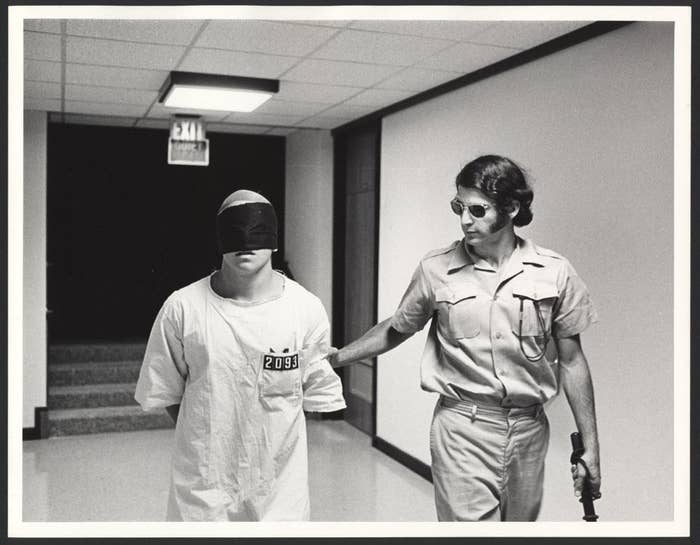
A prisoner is escorted in one of the Psychology building hallways.
Progressive reduction of humanity is the catalyst for sin in respect to the Stanford Prison Experiment. As the prisoners became less human they simultaneously became more like toys to the guards. From this point sadistic games were created that allowed the guards to feel as though they had control over them and their actions; in their own way they played god. This behavior was thrilling to them, and it acted as a positive feedback loop: increasing in intensity until someone finally put a stop to it. It is interesting that sexuality has such a continued use in this form of dehumanization, but it is simultaneously unsurprising. Sexual crimes are often some of the most impactful psychologically so, if trying to strip a human being of their humanity, they work incredibly well.
Analyzing Zimbardo’s work and the real-life parallel of Abu Ghraib one may wonder, “why didn’t anyone say anything?”. The inaction of some powerful group or person is often given as the reason certain atrocities are allowed to happen; a key example is how none of the SS soldiers spoke out against the slaughter of Jews in concentration camps. This lack of correction, I believe, may be one of the key reasons why behaviors continue to worsen and, thereby, develop into what we can generalize as sin.
Often we are left in a situation where we must debate the goodness or badness of a certain action. This is depicted comically here with the character Kronk from Emperor’s New Groove.
In Paul’s second letter to the Corinthians he discusses the sins of the people and rebukes them, seeking to correct their behaviors before he comes to see them again. Paul is skilled at rebuking those who are doing the wrong thing, and his corrections often help to move the rebuked back onto the right path for further development. Paul’s rebukes serve to save the people of Corinth from reducing their self-value and, more importantly, their reverence for their fellow man. One of Paul’s major issues with the Corinthians is their quarreling with one another. The greek word used for this is eris and it is best seen as a rivalry of sorts (the same word is used for when the disciples debate who was the one who would sit at Jesus’ left hand) and is a dangerous concept. This same rivalry is what drives the guards in the Stanford Prison Experiment to progressively become more dominating of prisoners; people will do whatever it takes to be the best.
A guard escorts a prisoner with baton in hand.
Paul’s goal to stop this squabbling between the Corinthians meant that he was preventing them from devaluing each other, and possibly inflicting harm. The Rwandan genocide described in the beginning of Zimbardo’s book had its start in the very same manner; the Hutus and Tutsis had a social rivalry as each vied to be the dominant group. Ultimately violence became the means of suppression, something that could have easily happened in Corinth.
Bones of some of the victims of the Rwandan genocide.
It is often debated if humans have an inset morality that keeps them from doing evil. Biblically we believe that humans have fallen from perfection and live in sin. Experiments like the Stanford Prison Experiment and events like the Rwandan Genocide are good illustrations of this capacity for evil. However, there is hope in the fact that certain factors can decrease the chance of such things happening, including being rebuked for your actions. Paul’s rebukes are done in the name of the glory of God, and they help to buffer the morality of the recipient to better act their role in society. In many ways, Paul served as one of the first people working against dehumanization.
Looking at Zimbardo’s work one thing can be seen as abundantly clear; when there is a group of people validating one’s actions there is a tendency to further disregard possible long-term effects and consequences. Contemporarily we see this in many social institutions, including the church. With this in mind, one can understandably fear how power dynamics created by corrupt/alternatively motivated people in positions of authority within these social institutions may be used negatively, either for personal gain or to attack an opposition. This fear is legitimized largely for the same reason that Abu Ghraib was allowed to happen; no one will risk standing in opposition as a crowd gathers or a system of behaving takes hold. One would be hard pressed to find a person who would openly rebuke Joel Osteen about his perspective on God and money during a Sunday morning message.
Joel Osteen is a prolific “prosperity gospel” preacher that has been subject of numerous controversies over the years, most recently his denial to host Hurricane Harvey survivors in his multi-million dollar church in Houston, TX.
This lack of a resisting force is a major enabler of groupthink. Within the Stanford Prison Experiment this can be seen in the escalation of the punishment rituals used by the guards; no voice spoke out to reduce the intensity, so the only thoughts being aired were in support of further punishment. This problem is common in sects of the church, particularly those that are unnaturally venomous or pro-conflict. The Westboro Baptist Church is a good example of such type of groupthink. Consisting only of likeminded parishioners, the congregation is a thunderous voice against abortion, homosexuality, and the separation of church and state; they are often found picketing something or someone that they believe is a threat. At these pickets the Westboro Baptist Church demonstrates behavior that many view as objectionable, and certainly not living up to the standards set forth by Christ (so much so that some believe they are simply “trolls” rather than legitimate Christians).
A Westboro Baptist Church member pickets in Washington D.C.
With the knowledge that these two types of groups exist, there is an ethical call for modern Christians to search for truth in the biblical text and how it applies to the contemporary life of the church. This need for critical traditioning is something that must be taken seriously, or it is likely that the two aforementioned archetypes will continue to intensify and expand their reach. Allowing these groups to expand their reach would likely catapult the whole of Christianity into a similar situation to the Crusades; joined against a single enemy that is, truly, fabricated and exaggerated. Unfortunately, the enemies of militant Christians are very uneasy with the idea of church, and the relationship of youth (with Generation Z being the most socially minded generation ever) is increasingly worsening as those selected against are persecuted. Richard Rohr, a prominent Franciscan friar and biblical scholar says it best in his own blog post when he states,
Of the many radical things said and done by Jesus, his unflinching emphasis on love was the most radical of all. Love was the greatest commandment . . . his prime directive—love for God, for self, for neighbor, for stranger, for alien, for outsider, for outcast, and even for enemy, as he himself modeled. The new commandment of love [John 13:34] meant that neither beliefs nor words, neither taboos, systems, structures nor the labels that enshrined them mattered most. Love decentered everything else; love relativized everything else; love took priority over everything else—everything.
Richard Rohr
The emphasis on love in the Christian mission is something that must be used in order to overcome the darkness present in the human condition. It is love for creation and for his fellow man that allowed Clay to act as a martyr in the experiment, and it is this same sacrifice and love that we all must take upon ourselves to combat our own “Correctional Officers”.
Thank you for continuing with me in the process of analyzing The Lucifer Effect! Over the next three posts I will examine how biblical rebukes helped combat dehumanization, how domination and sexuality have a strange connection (both biblically and in the Stanford Prison Experiment, and I’ll finish off with how an ideal Christian mission (one focused on love) can help prevent the descent into sinful action.
Abu Ghraib was one of the most damning situations to come out of Iraq during the initial occupation of the country by the US following the events of 9/11. The images that were revealed to the public were horrifying, graphic, and disturbingly sexual. The question that many had was “Why?” and this is something that Dr. Zimbardo is willing to answer.
An infamous, almost crucifixion-esque photo from Abu Ghraib. This prisoner had wires attached to his fingers, neck, and genitals and was told that if he fell at any point during the night he would be electrocuted. He was kept this was for several hours.
The operators of the Abu Ghraib Tier 1 block were military police reservists, and some higher ranking Army officers who orchestrated the shifts and kept piece with the function Iraqi police at the facility. These officers were tasked with grueling hours and scarce rations due to the sheer volume of staff that had to be fed. The working situations were highly volatile, with many of the Iraqi police being willing to sell escape plans, drugs, and even weapons to inmates for a fee. The population housed was both male and female who had varying charges from direct collusion with Saddam Hussein to petty theft and prostitution. Worst of all, populations of 50+ were housed in large section-like cells that offered little ability to isolate problems effectively. The officers were often subjected to being in a room of prisoners who may or may not be armed with no ability to discern if the primary threat was the 75 year old man, or the 10 year old boy; the fear was immense. Coupling this with the rhetoric of “every failure to find intel is another American dead” purveyed by infantry soldiers and intelligence officers who visited there was an increased pressure to be the hard point of the spear and lead the way through the muddy waters.
Trained attack dogs surround a naked prisoner.
The 10 personnel who took part in the torture at Abu Ghraib included both men and women, which is the likely reason for why the sexual component of the torture was so pervasive. Several of those involved in the torture were romantically involved with each other, taking time during their shifts to sneak off to engage in sexual activity in various illicit areas in the prison. This blending of fear, power, contempt, and sex is evident in the photos that emerged as well as the continuing attitudes of those involved; many feel as though they were justified in their behaviors. Dr. Zimbardo feels that, similar to those in the Stanford Prison Experiment, isolation, personal insecurities, social conditioning and, and deindividuation are leading components to the atrocities that were encouraged among the tight knit group of guards. Their actions brought them close together and even led to the commemoration of them in the photos of Abu Ghraib, taken as trophies rather than evidence.
The infamous naked pyramid. Notice the smile of Lynndie England.
So what does Dr. Zimbardo suggest be done about such situations? Can we possibly prevent these things from happening? What is too much power and what is not enough? These are ambiguous questions that are hard to answer. Dr. Zimbardo suggests that the correct course of action is to prevent situations in which stark in-group out-group rhetoric can be utilized and ensuring that in all cases of power there is a balance. The character displayed by Clay in the Stanford Prison Experiment is in many ways a key component to creating a global character that will prevent such actions. Having a highly internalized core belief of universal morals that acts as a transformative basis for life can likely limit the extent to which these situations can contaminate those in them. In addition to this, the sheer knowledge that situations can foster evil is important and should be something that is continually talked about in educating the future and current generation.
The Stanford Prison experiment is, fundamentally, an experiment from which data was supposed to be extrapolated from to analyze the function of imprisonment. Because of this, there are several scales indicating changes within the participants over the course of the experiment (remember, it was shortened to the four days). Perhaps the most compelling data recorded is the profiles of the participants in the Comrey personality scales. The Comrey personality scales is a set of eight sub-scales that are used to assess the total character of a person; these scales are Extroversion, Masculinity, Empathy, Trustworthiness, Orderliness, Conformity, Stability, and Activity. These dimensions were dominated by several key prisoners in the study; Clay, the resident Gandhi, scored highest for Trustworthiness while Sarge scored highest in Activity (explaining his liking of the severe workout punishments). Strangely enough Hellman, the most objectively cruel guard, was the lowest score in masculinity. Dr. Zimbardo speculates in his book that some of the sadistic homoerotic situations he devised may have been an assertion made by his questioning sexuality (however, his behavior post-experiment does not endorse this). After the Comrey scales is the other major point, that of the F-scale; a measure of rigid adherence to conventional values and submission without critique to authority. The average of the 10 prisoners who circulated through the experiment was, initially, 4.4. For those 5 prisoners who endured the entire experiment, there was a near doubling of this value from 4.4 to 7.8 while the five released averaged around 3.2. When looking at the success of the prisoners in adapting to the stressful situations those who had higher F-scores were more adept, and subsequently were reinforced in their behavior overtime, increasing their scores.
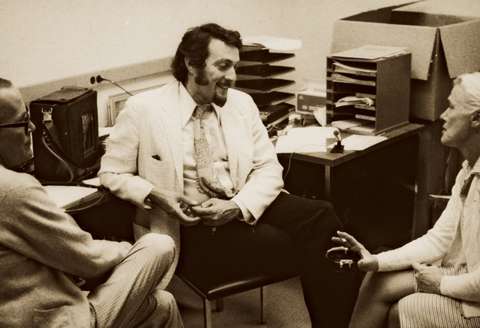
Dr. Zimbardo speaks with a colleague. Some of the recording equipment and documentation for the experiment can be seen in the background.
Beyond the hard data of the Stanford Prison Experiment is the meaning derived from the actions observed in video and audio analysis of the events that unfolded. A clear observation is the creation of a power dynamic and the justification that occurred because of such. As the guards cemented themselves in the hierarchy the behaviors became more methodical and sinister, toying with the prisoners rather than simply punishing for deviant behaviors. In the same way, this incessant toying destroyed the wellbeing of the prisoners, leading to rapid progression of acute psychological pathologies among those who were most abused (and most likely to respond poorly to such abuse, such as Doug). This power dynamic gave the terrible authority to determine rules and regulations in the experiment which, effectively, shapes the reality of the participants. The rules that the prisoners had to submit to (or else be punished) were profound tools in making their roles very real to them. In addition to the power dynamic, as the guards were lost behind their identical uniforms and general title of “Mr. Correctional Officer” they became anonymous in many way, effectively distancing themselves from their own actions; looking at a prisoner behind reflective glasses gives a sterilized scientific feeling to the interactions had. The deindividuation of the guard role also led to a cognitive dissonance between action and belief, aggregating the effects and promoting further sadistic behavior. This sadistic behavior, in turn, led to further acceptance of that guard as the in-group. The dehumanization of prisoners, the creation of a reality in which they are sub-human and worth less as a collective than one of the in-group, is a key reason atrocities like the Holocaust are possible.
A photo of one of the guards during the experiment. Notice how, beyond things such as frame and hair color, a group of men could be fairly identical when dressed this way, promoting deindividuation.
Dehumanization is the reduction of a social group into something less than human while deindividuation is the removal of responsibility and restraint when in a situation where your direct involvment is not known. In the Stanford Prison Experiment prisoners were reduced to “in-process” humans, lacking something that would have made them productive members of society. For this reason, rehabilitation and conditioning of them to follow rules was justified (in the same way Hitler justified extermination of the Jews) and thus the behaviors of the guards were created. Once a large enough status-quo was created the deindividuation of appearance and situation made everything permissible; letting deeper angers and frustrations out to be vented on the prisoners became acceptable because it would not result in punishment, and likely would increase belonging and bonding with the fellow guards. This behavior cycle is easily extrapolated into larger situations, and is evidenced clearly in the behavior of the operators at Abu Ghraib prison in Iraq.
The Stanford Prison Experiment was an experiment executed by Dr. Philip Zimbardo on Stanford’s campus in August 1971. The experiment was originally intended to be a two week study on the social effects and dynamics of imprisonment and the prison system as a whole. Unfortunately, due to the dramatic and detrimental effects had in the first 5 days, the experiment was cut short and dismantled; it is now infamous for the vile situation it created. Taking from those who responded to an ad in the paper they selected 9 men to act as the prisoners and 12 to act as guards (3 shifts of 3 guards and 3 back-ups). These men were promised compensation for the experiment with each of them being paid $15/day over the two weeks. The experiment was notably funded by the Office of Naval Research in order to study antisocial behavior, which is why a relatively large amount of money was offered. The prison was constructed in one of the basement hallways of Stanford’s Jordan Hall, the Psychology building, and was isolated from the paths of the graduate students and professors who may interrupt the experiment. Dr. Zimbardo took on the role as the prison’s Superintendent and used his current graduate students and a former prisoner as consultants in constructing and running his prison. The experiment began promptly at 9:55 A.M. on Sunday August 14, 1971 as Dr. Zimbardo drove along with two Palo Alto Police officers, arresting the participants and taking them to be booked into the “Stanford County Prison”.
A modern picture of the hallway used for the Stanford Prison Experiment.
Sunday: Booking
On Sunday August 14 Dr. Zimbardo arrived at the Palo Alto Police station expecting to have police waiting to assist him, as was previously promised to him by Chief Zurcher of the department. Unfortunately, due to miscommunication and Zurcher’s absence, there was no such group waiting for him. Dr. Zimbardo employed a slight bit of social manipulation, promising screen time to the Palo Alto policemen that aided in the arrest of the participating prisoners. The reluctant agreement led to video such as that in the previous paragraph being captured as the participants were rounded up one-by-one. The arrests of three of the 9 prisoners is detailed in the narrative; Prisoner 8612 (Doug Karlson, the man seen in the linked video of the arrests), Prisoner 7258 ( Hubbie Whittlow, a recent high-school graduate attending Berkley after the experiment), and Prisoner 2093 (Tom Thompson, a socially awkward, rigid, militaristic type Stanford Student who had spent the summer living in his car and attending summer school). Each of these arrests reflect the respective personalities of the prisoners and provide a comparison for how the experiment changes them over time. Doug is a a recent Berkley graduate and a vehement anti-war advocate who very nearly went to prison for organizing a rally the previous year; he is strong willed and anti-establishment. Hubbie is young and enamored with his high-school girlfriend; he is immature and free-spirited. Tom, who quickly earns the nickname of “Sarge” is so compliant that he seems to take enjoyment from the punishment in the coming days; he shows a will to submit, but paints a key portrait of the line between authoritative action and torture. After being booked into the prison all 9 prisoners are stripped naked, deloused, and separated into their respective cells (three converted rooms with three men to a cell, each man having a cot of his own). The rules are explained to the prisoners as a whole and they go through their first set of “counts” as a prison in which they are required to sound off. As the day shift turns over to the night shift the derivations of counts begins and the guards begin to establish dominance by asking prisoners to count in ludicrous ways (backwards, by room, by height, by weight) and punish them with push-ups for any mistakes. The beginnings of resentment are seen in the prisoners as they comply, and are worsened when the morning shift has their counts, waking them all from a dead sleep at 2:30 A.M. With the immediate brutalization, it is no wonder that Monday starts a long list of rebellion within the Stanford Prison.
Monday: Rebellion
Beginning with a wake-up call at 6 A.M. the prisoners are at the mercy of the morning shift guards; Correctional Officers Vandy, Ceros, and Varnish. Being as there were no toilets in the basement hallway, all prisoners must be taken one-by-one to use the facilities on a separate level. Prisoner 819 (Stewart) finds these new rules funny and is the first prisoner placed in solitary or “The Hole” (a converted file closet) due to his behavior. While inspections are taking place in the cells Officer Vandy and Prisoner 8612 (Doug) scuffle after Vandy tears the covers off of 8612’s newly made cot. This scuffle earns 8612 placement in The Hole as well and it is here that they begin to plan their personal rebellion against their oppressors. Before either 819 or 8612 are able to enact their plan the first act of rebellion is made by the occupants of Cell 1- Prisoner 5704 (Paul), Prisoner 7258 (Hubbie), and Prisoner 3401 (Glenn). Cell 1 has barricaded themselves in their cell, preventing guards from being able to enter. The guards frustrations are borne onto Cell 2 and both Prisoner 8612 and 819 and their cellmate Prisoner 1037 (Rich) have their cots taken out by the guards into the yard (the hallway). The guards begin using fire extinguishers to subdue prisoners with jets of carbon dioxide and remove the cots from Cell 3 as well (though Cell 3 willingly submits their bed to the guards). Rebellion continues as Cell 1 plans an escape and Cell 2 has both Prisoner 8612 and 1037 thrown into The Hole for refusing to cooperate. After this madness, a grievance board is constructed and meets with Dr. Zimbardo who, in true fashion of his role, assures that the concerns of the prisoners will be dealt with assuming their compliance with the rules. Prisoner 8612 does not believe this and demands violently to see Dr. Zimbardo personally saying that he wants to leave. While meeting with Dr. Zimbardo Prisoner 8612 is berated by Carlo Prescott, a former prisoner, for being so “soft” in the first day and Dr. Zimbardo suggests that prisoner 8612 act as an informant to help reduce the hassling done to him by the guards, which only seems to worsen Prisoner 8612’s outlook. After returning voluntarily to the prison Prisoner 8612 begins to spout delirious statements about an inability to leave, and ultimately is put into The Hole again where he screams maniacally. After his release from solitary he is assessed by Craig Haney, a graduate student in Psychology, who suggests that he is unfit to continue the experiment and will be released home.
Tuesday: Visitors and Rioters
Tuesday begins and continues in a similar manner to Monday with increasingly deranged counts, and additional monotonous routine imposed by the guards on the prisoners. Prisoner 8612 (Doug) is replaced by David, another graduate student who, it is hoped, will act as the informant in the prison. However, evidenced by his refusing to inform of another prisoner stealing handcuff keys, it can quickly be seen that David has taken the role as prisoner, and not informant. The prisoners are allowed to write a second round letters out to friends and family who are unable to visit them, before they are then groomed and instructed to prepare the prison for the impending visitors; the family in the area. The letters written are vetted before being sent, and it is found the Prisoner 5704 (Paul) is intending to write a piece for several guerrilla newspapers about the experiment and its use as a “government funded experiment on detaining anti-war protesters”; this angers Dr. Zimbardo who states that he has begun to feel the need to “protect my prison”. Dr. Zimbardo is not the only one whose identity is beginning to slip; as guards come on and off their shifts they express more disdain for the “prisoners and their prison stink” and take more and more pleasure in tormenting their captives during their counts. Once the whole of the prison is prepared for the night, the first visitors arrive. Prisoner 819 (Stew) is the first to visit with his family. The visits are closely monitored by the guards and many guests (including Stew’s parents) choose to remain purposely distant and keep their appearance short. The mother of Prisoner 1037 (Rich) begins to raise a fuss that she feels her son may be becoming depressed to Dr. Zimbardo who, losing himself in his role as Superintendent, convinces the mother with the help of her husband that “your son can take it”. This tactic of challenging masculinity works exceedingly well on reinforcing continuation in the study. After the visiting night is over the prison prepares for a suspected attack by Doug (the former Prisoner 8612) and his friends, a rumor that has been circulating since Doug’s release the previous night. To dissuade rioters the prisoners are taken with bags placed over their heads and stored in a lecture room on the third floor as Dr. Zimbardo waits in a destroyed prison yard for the rioters. These rioters turn out to be nothing more than rumor, and the prisoners are brought back and placed in their cells.
The families of the prisoners wait with a guard on visitor night.
Wednesday: Control Begins to Spiral
Wednesday follows the same scaffolding of the two previous days with one major exception; a priest has been brought in for religious counseling at request of the grievance board. This priest, Father McDermott, is used to serving in prisons and feels that he can add to the realism of the situation. The meetings with Father McDermott are uncomfortably real as prisoners speak, and are spoken to, as if their situation is much more permanent and real than it actually is; the experiment has now taken root in nearly all participants as a sort of accepted reality. This is especially visible in the reactions of Prisoner 819 (Stew). In a fit of rage this morning 819 destroyed his pillow, raining feathers all about his cell (which he was then forced to clean). During his meeting with Father McDermott Prisoner 819 breaks down sobbing, stating that he is stressed, anxious, and has a headache. Dr. Zimbardo collects him from Father McDermott and lets him sit in a quiet room while attending to some other work. During this time Officer Arnett begins instructing the prisoners in a chant of “Prisoner 819 did a bad thing” and “Prisoner 819 is being punished”. Returning to Prisoner 819, Dr. Zimbardo finds him huddled over continuing to sob, stating that he wants to return to the experiment to prove that he is not a “bad prisoner”. Dr. Zimbardo focuses on the odd instance in which he assure Stew that he is not Prisoner 819 and the sudden snap to awareness (“as if he was a child awakening from a nightmare”). After this breakdown it is decided the Stew can no longer continue the experiment and he is released.
Prisoner 819 (Stew) cries in the quiet room.
In replacement for Stew a new prisoner, Prisoner 416 (Clay), is brought into the study. While at lunch Clay, observing the terror that he has been placed into, absolves to resist his abusers by going on a hunger strike, grasping the two sausages from his meal in defiance. This act is infuriating to the guards and they place him in The Hole and threaten the entirety of the prisoners; if Prisoner 416 does not eat they will not be able to have their scheduled visitors. This threat is found to be baseless, but still promotes animosity among the prisoners; their actions affect the whole. After visitors the guards play a new game; they force the prisoners into different behaviors and scenarios. Officer Hellman is the primary perpetrator of this, insisting that the prisoners act out scenes (such as Frankenstein and the Bride of Frankenstein) and requesting they engage in and say homoerotic things to each other. The further that he is able to push the prisoners, the more perverse his orders become. Ultimately, these behaviors are stopped when Prisoner 2093 (“Sarge”) states that he will not participate as the behavior is “kind of obscene”. Officer Hellman continues to promote inter-prisoner violence as he orders them to demean and threaten Prisoner 416 (who still refuses to eat his sausages). Prisoner 2093 yet again refuses, and stands firm in his moral identity. The antics to try and crack Prisoner 416 continue as he is subjected to more solitary confinement, verbal abuse, and serves as the catalyst for all of the prisoners being offered dirty, burr covered blankets unless 416 yields; none of these tactics work however as the prisoners have bonded against their oppression in a way. An amazing thing to know is that, although there is a “parole” meeting held this day with the offer to leave the experiment without compensation, no prisoner takes this offer, stating in later interviews that “we didn’t even think of it as an experiment anymore…it was a prison run by psychologists”.
Thursday: Confronting the Demons
Thursday serves as a primary turning point in the experiment; it is the day that Dr. Zimbardo comes to the realization that his actions are having a legitimately damaging effect on himself and the prisoners. Christina, a graduated PhD in Social Psychology (and lover to Dr. Zimbardo) takes up work on the project only to find that the conditions have become increasingly sadistic. Using her position as both a colleague and loved one of Zimbardo she presents the reality of the situation and pleads that the experiment be stopped prematurely. By this point two additionally inmates have been deemed psychologically unfit to continue, and another discharged for medical reasons (a large rash). Dr. Zimbardo, taking Christina’s advice, decides that he will close down the experiment the next morning. Unknown to Dr. Zimbardo at the time, this last night is the most profoundly disturbing in terms of guard behavior. Officer Hellman has progressed to having the prisoners simulate sodomizing one another as “female and male camels”. This extreme change, in only four days, has to do in part with the fact that Hellman is the largest of the night guards and has thus taken position in the hierarchy.
Friday: Breaking Down the Institution
Friday is the end of the experiment. After an innocuous count the prisoners and guards are informed that their roles have finished. The rush of joy on the part of the prisoners is immense and the resentment felt by the guards is (even to themselves) quite strange. The experiment, after only 5 days, had elicited behavior that was so repulsive many of the participants needed therapy following their finishing. It is, in many ways, a painting of how one may be seduced into behaving in an evil way.
Phillip Zombardo begins The Lucifer Effect by explaining his thesis and purpose of the book; to try and explain why ordinary people are driven to do terrible and deranged things. First, the nature of evil is debated as being separate, a contaminating entity that bends people to its will, or inherent and mutable, a capacity that can be flexed and developed throughout life events. Deciding on the idea of an inherent capability, three forms are examined; dispositional, situational, and systemic evil. The first of these is dispositional evil and is the common form that most people use in a knee-jerk judgements. When looking at people who commit violent crimes it may be said “it’s just who they are” or “they were born evil”, but Zimbardo argues that this is not the case. Dr. Zimbardo suggests that the situations and systems that a person interacts with are the cause of the illusion of dispositional evil.
This theory is explained through the idea of creating an in-group and out-group and creating a purpose, goal, or vision involving the two. Zimbardo suggests that this tactic is why Germany bent to Hitler’s final solution as the Jews were established as the “other” through propaganda and the idea was sown that they needed to be eliminated for the good of the society. Further examples are given in the Rape of Rwanda and Rape of Nanking; for the sake of brevity we will just address the Rape of Rwanda. In Rwanda the majority Hutu established an idea of removing the Tutsi sub-group by mass genocide. Almost overnight, conditioned by their tribal officials and offices of power in the government, bands of Hutu people went through their villages, killing their neighbors who were now perceived threats. The use of rape was quickly instituted to demoralize remaining Tutsi peoples and bond the assailants together in their actions. A specific account reported a boy being forced (“with a hatchet to his throat…”) to rape his own mother as his siblings restrained her; they were then killed as others fled.
A Zambian soldier overlooks a destroyed Rwandan refugee camp.
Trials following the Rape of Rwanda cited similar phenomena to the Nuremberg Trials, the notion of “I did what was expected, not because I wanted to, but because I was asked to”. These atrocities are done by typical people, largely without guilt, because of the distancing of the self from the other, or dehumanization. The removal of one’s connection to another leads to behaviors that are beyond the scope of normal, and the macabre can be seen by the perpetrators as entertainment. Zimbardo notes that this concept will be addressed in greater detail in regards to his Standford Prison Experiment, his infamous study that resulted in atrocities of its own, and the events of Abu Ghraib prison in Iraq before ushering in the summary portion of the book.














 A Peek Inside